


وبلاگ
How AI Transforms Language Learning

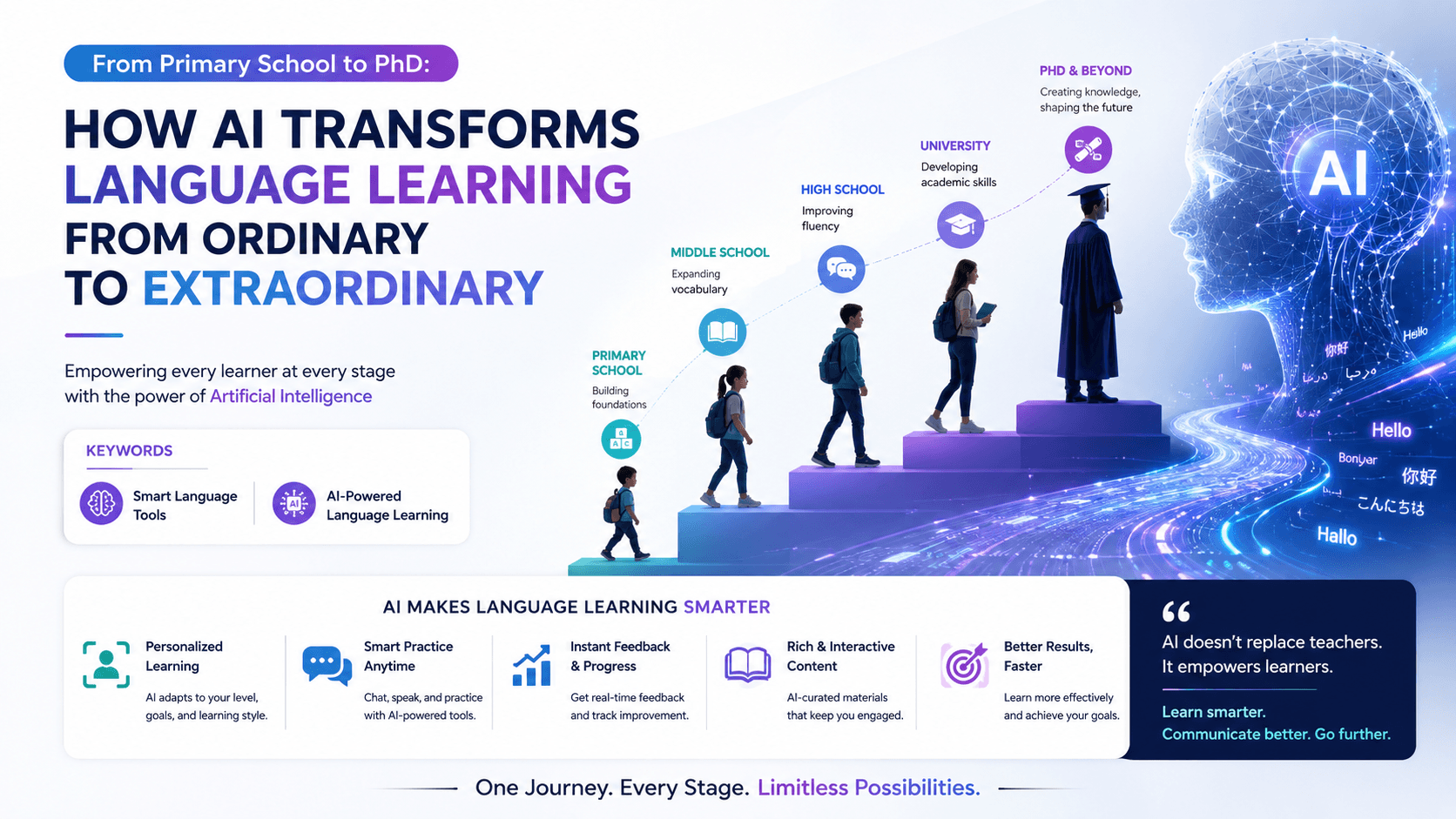
The Teacher Who Never Sleeps
Imagine a private tutor who:
-
Answers at 3 AM without complaining
-
Teaches you Australian, Indian, or Irish accents separately
-
Has analyzed thousands of your sentences and knows your exact error patterns
This isn’t science fiction. This is AI in language learning today.
But here’s the problem: 90% of learners use only 5% of AI’s potential. They treat ChatGPT like a fancy dictionary, Google Translate like a magic wand, and never move beyond basic translation.
The difference between casual and professional use of AI in language learning is like the difference between a bicycle and a rocket ship. This article gives you the rocket blueprint.
Casual Use – What 90% of Learners Actually Do
At this level, you treat AI as a passive tool. Typical behaviors:
-
Translating word-by-word without asking “why”
-
Asking “What’s the synonym of X?”
-
Requesting corrections without understanding the error
-
Using chatbots to generate text instead of writing yourself
A concrete example of casual use:
User writes: “Translate ‘I went to the cinema yesterday’ into Spanish.”
AI translates: “Fui al cine ayer.”
User copies it. Done. Nothing learned.
What you lose at this level:
| Lost element | Why it matters |
|---|---|
| Error analysis | You never learn why you keep mixing up past tenses |
| Personalization | AI doesn’t know your specific weak points |
| Spaced repetition | New vocabulary dies in short-term memory |
| Cognitive challenge | You receive answers without thinking |
The result: You feel productive, but in real conversations, the same mistakes keep coming back. Casual use = getting answers. Professional use = rebuilding ability.
Professional Use – Designing an Immersive Intelligence Environment
This is where the magic happens. A professional learner uses AI as a coach, scenario designer, performance analyst, and training partner.
Key Features of Professional Use:
1. Scenario-Based Role-Play with Unexpected Twists
A casual user says: “Practice English with me.”
A professional user says:
“Play the role of a tired, annoyed check-in agent at Paris Charles de Gaulle Airport. I’m a passenger whose flight was delayed and I missed my connection. Simulate a French-accented English. Give me false information twice so I have to ask clarification questions. Keep your responses short and irritable.”
This level of detail transforms AI from a chatbot into a language sparring partner.
2. Systemic Error Pattern Analysis
Instead of single-sentence correction, ask AI:
“Analyze my last 100 sentences. Extract 3 recurring grammatical error patterns. For each pattern, create 5 practice sentences that specifically target that mistake. Do not correct them — let me find the errors first.”
3. Vocabulary Consolidation Through Personalized Storytelling
Flashcards are boring. Professional method:
“Take these 15 medical vocabulary words I’ve been learning. Write a short crime story where I’m a detective interrogating suspects, and I have to use these words naturally. Write at B2 level. After each paragraph, ask me one inferential question about the text.”
4. Accent & Pronunciation at the Phonetic Level
Tools like Elsa Speak and Speechling (AI-powered) give feedback on:
-
Vowel length (ship vs. sheep)
-
Voicing (thin vs. then)
-
Intonation patterns in questions vs. statements
Pro tip: Record yourself, give the audio to an AI voice model, and ask for a formant map comparison with a native speaker (using tools like Praat + voice APIs).
5. Collocation Learning via Embedding
Casual user asks: “What’s a synonym for ‘important’?”
Professional user asks:
“In academic writing, what are the top 10 collocations for ‘factor’ (e.g., ‘critical factor,’ ‘contributing factor’)? Give me frequency data from a corpus like COCA or Nature abstracts, with example sentences at a C1 level.”
Comparison Table (Infographic-Ready)
| Dimension | Casual Use | Professional Use |
|---|---|---|
| AI’s role | Translator / Dictionary | Coach + Designer + Analyst + Partner |
| Feedback | “This is wrong” | “Why it’s wrong + frequency + targeted exercise” |
| Personalization depth | None (single-prompt) | Based on hundreds of past interactions |
| Cultural input | Neutral, sometimes wrong | Dialect-aware, context-rich |
| Retention | Low (quick forgetting) | High (spaced repetition + narrative anchoring) |
Key Tools for Professional Use (And Exactly What to Do With Them)
| Tool | Professional Use Case |
|---|---|
| ChatGPT (GPT-4 or higher) | Build dynamic role-plays; get structured corrections (error + reason + exercise); analyze your writing style against 10 reference texts |
| Claude (Anthropic) | Long-context analysis. Upload a 500-page book and ask: “Extract rare vocabulary by chapter and create cloze deletion flashcards.” |
| Elsa Speak | Record 50 sentences; receive a heatmap of your phonetic weak points (e.g., “70% of your errors involve /θ/ and /ð/”) |
| LingQ + AI Summary | Import real texts (blogs, work emails, research papers). AI highlights unknown words and generates an audio summary for listening practice |
| Quizlet with Q-Chat | “Based on my mistakes last week, create 20 flashcards — but make 5 of them deliberately misspelled so I have to find the error.” |
| NotebookLM (Google) | Upload your language learning notes. NotebookLM turns them into a two-host podcast dialogue you can listen to while driving |
Sample Advanced Prompt for ChatGPT:
“From now on, act as a Cambridge exam grader. Classify my errors by CEFR level (A1–C2). Categorize each error into: verb tense, preposition, word order, or collocation. After every 5 sentences, give me a ‘pattern alert’ if the same mistake repeats.”
5-Step Practical Guide to Move from Casual to Pro (Starting Tomorrow)
Step 1: Log Your Behavior for One Week
Write down every interaction you have with AI for language learning. At the end of the week, ask: “What percentage of my prompts were simple translation or definition requests?”
Step 2: Change Your Prompt Structure Using the SPAR Framework
| Letter | Meaning | Example |
|---|---|---|
| Situation | Context (job interview, restaurant, apology) | “I’m checking into a hotel in London” |
| Persona | AI’s role (IELTS examiner, annoyed friend, travel agent) | “You are a busy receptionist” |
| Action | What AI should do (simulate, analyze, create exercise) | “Simulate the check-in conversation” |
| Request | Output format (table, bullet points, quiz) | “Give me feedback in a table with three columns: error, reason, fix” |
Step 3: Mandatory Daily Role-Play (10 minutes minimum)
Every day, pick one scenario from this list and role-play with AI for 10 minutes:
-
Returning a defective product to a store
-
Apologizing to a friend for missing their wedding
-
Negotiating a freelance contract price
-
Explaining a technical problem to IT support
Step 4: Weekly Feedback Session With Yourself
Ask AI at the end of each week:
“Summarize all our conversations from this week. List:
The 5 words I mispronounced most often
The 3 grammatical structures I used correctly (with examples)
The 3 structures I still struggle with (with examples)
One specific exercise to fix my most frequent error”
Step 5: Monthly Adaptive Progress Report
At the end of each month, ask:
“Compare this month to last month. Give me:
Quantitative improvements (e.g., ‘20% fewer preposition errors’)
Qualitative improvements (e.g., ‘your sentence flow is more natural’)
At-risk-forgetting points (vocabulary you haven’t used in 3 weeks)
Recommended focus for next month (1 skill only)」
Professional Warnings – Three Mistakes That Kill Your Progress
1. Absolute Dependency
If you cannot write a single correct sentence without AI, the tool has weakened you, not strengthened you.
Solution: Always write your answer manually before asking AI for feedback. Then compare.
2. Passive Content Consumption
Listening to AI-generated podcasts or reading AI summaries without interaction is like watching workout videos from your couch.
Solution: Ask AI to pause after every paragraph and ask you an open-ended question. Answer aloud.
3. Accent Homogenization
Most AIs default to standard American or British English. If your goal is Irish, Australian, or Indian English, you must be explicit.
Solution: Add to every voice-related prompt:
“Please speak with a Melbourne accent, including rising intonation at the end of statements (Australian ‘high rising terminal’).”
Conclusion – AI Is a Multiplier, Not a Replacement
AI cannot do the hard work for you:
-
It cannot force you to do spaced repetition
-
It cannot write your journal entries
-
It cannot drill conjugations into your muscle memory
But it can multiply the quality of every 30 minutes of practice by 5x.
The difference between a casual user and a professional user comes down to two things:
-
Prompt engineering – the ability to design targeted exercises
-
Metacognition – the ability to analyze feedback and adapt
Now that you’ve read this article, if you still use AI like a dictionary, you have no excuse.
Ready to stop being a casual user and become an architect of your own language learning?
Write your first professional prompt. Right now.
Appendix – 5 Professional Prompts to Copy and Use Today
Prompt 1: Error Pattern Mining
“Here are 20 sentences I wrote this week. Identify my top 3 error types. For each error type, give me: (a) the rule, (b) 3 correct examples, (c) 3 incorrect examples where I have to spot the mistake.”
Prompt 2: Accent Shadowing Script
“Write a 200-word monologue in a New York accent (non-rhotic, ‘cawfee’ instead of ‘coffee’). Include at least 5 examples of ‘aw’ vowel shifts. I will use this for shadowing practice.”
Prompt 3: Debate Simulation
“Let’s debate: ‘Remote work is better than office work.’ You take the pro position. I’ll take the con. After every 3 exchanges, pause and give me feedback on: (1) my argument structure, (2) my use of transition phrases, (3) one vocabulary upgrade suggestion.”
Prompt 4: Email Tone Transformation
“Take this draft email I wrote (angry tone). Rewrite it in three versions: (a) polite but firm, (b) diplomatic for a Japanese business context, (c) casual for a colleague. Explain 3 key word changes you made in each version.”
Prompt 5: Listening Comprehension + Inference
“Tell me a 1-minute story about a waiter who finds a lost wallet. Then ask me 5 questions: 3 factual, 2 inferential (‘Why did the character do X?’). After I answer, rate my
listening accuracy on a scale of 1–5.”
.This article is presented by the Educational Group of Tose`e Danesh Khalagh Company
